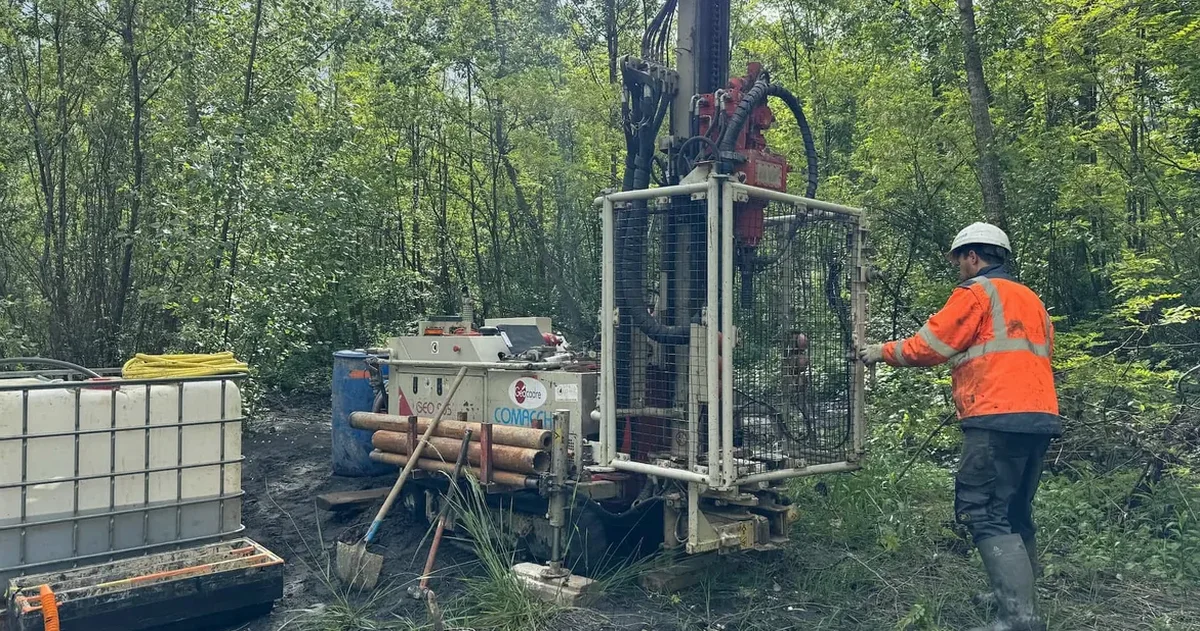
Too many earthworks tenders in Toowoomba go over budget because the initial desktop study missed a lens of reactive clay or a pocket of loose colluvium on the range slope. Contractors bid on clean basalt, then hit deeply weathered material that won’t compact above 92% modified density. A proper soil mechanics study eliminates that gap between assumed ground conditions and what the excavator actually digs up. Our technical team runs the full parameter suite—strength, consolidation, permeability, and chemical aggressivity—on samples taken from exactly the strata that will carry the load. For projects near the escarpment where fill thickness exceeds 3 metres, the lab program routinely couples classification testing with a triaxial campaign to define effective stress failure envelopes under the saturated conditions that dominate Toowoomba’s wet season.
Toowoomba’s red basalt clay can swing from stiff to soft in one wet season—classification alone won’t capture that risk.
Scope of work
Toowoomba sits on a geological patchwork: Tertiary basalt caps across the range crest, Jurassic Walloon Coal Measures on the mid-slopes, and alluvial fans spreading west toward the Condamine floodplain. That variety means a single borehole log is never enough. The basalt-derived red and black clays across Middle Ridge and Wilsonton are notoriously reactive—shrink-swell indices routinely exceed 5.0%, demanding moisture-controlled compaction and stiffened raft designs. Down on the eastern escarpment, colluvial deposits mix angular basalt fragments with silty matrix, creating drainage paths that concentrate water behind retaining structures. Our laboratory programme sequences classification tests with strength and consolidation stages so the design engineer sees not just the material type but how it behaves under load and saturation. The reporting format follows AS 1726-2017 nomenclature throughout, and every test result is traceable to a NATA-accredited procedure.
FAQ
How long does a complete soil mechanics study take for a typical Toowoomba subdivision site?
Site sampling usually takes one to two days depending on access and number of test pits or boreholes. The laboratory programme then runs three to four weeks for classification, strength, and reactivity tests. Consolidation stages add another week. A factual report with interpreted parameters is typically delivered within five weeks of fieldwork, assuming no re-testing is required.
What does a soil mechanics investigation cost for a residential block in Toowoomba?
For a single residential lot requiring classification, reactivity, and basic strength testing to AS 2870, the investigation and laboratory programme typically falls between AU$4,220 and AU$8,960. The range depends on access conditions, number of test pits or boreholes, and whether triaxial or consolidation stages are needed to satisfy the structural engineer’s requirements.
Do we really need triaxial testing, or is pocket penetrometer and Atterberg enough for a retaining wall design?
For any wall over 1.5 metres retained height, AS 4678 expects drained and undrained strength parameters that pocket penetrometer readings cannot provide. Triaxial testing gives the effective stress failure envelope the designer needs to model pore pressure build-up behind the wall, which is particularly relevant on Toowoomba’s escarpment slopes where colluvium drains poorly and saturates in wet months.