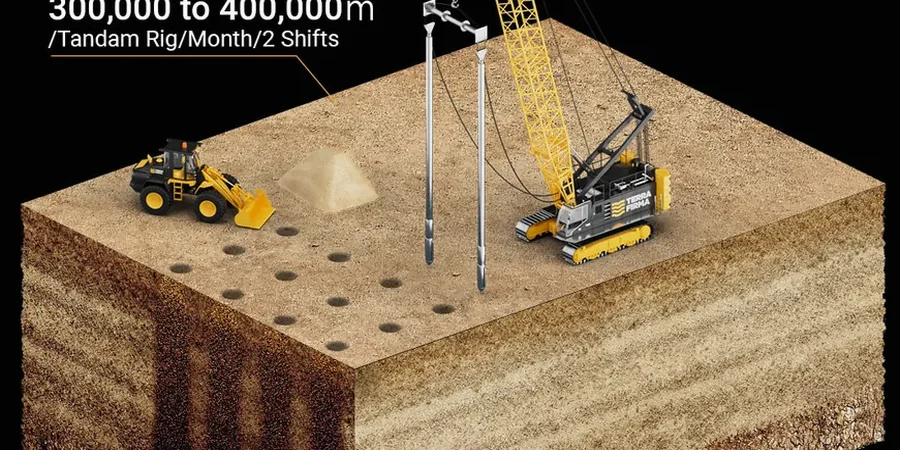
We have seen more than one project on the eastern escarpment of Toowoomba stall because the site investigation missed a lens of loose alluvial sand beneath stiff clay. The assumption that Toowoomba sits entirely on firm basalt is a costly one. Vibrocompaction design is specifically for those pockets of granular soil where depth vibrators can rearrange particles into a denser state, and when applied correctly it transforms a marginal site into buildable ground. Our team has worked across the Range, from the black soil plains west of the city to the decomposed basalt profiles near Prince Henry Heights, and the variability demands a design approach that starts with proper CPT testing to map the target zones. Without that data, you are guessing where the vibrator will actually be effective, and in Toowoomba’s mixed geology, guessing leads to differential settlement.
A well-designed vibrocompaction grid in Toowoomba's alluvial sands can increase relative density from 40 to over 80 percent in a single pass, eliminating deep foundation costs.
Area-specific notes
The vibrator rig used for compaction on Toowoomba sites is typically a crawler-mounted unit with a leader mast, capable of handling the electric or hydraulic vibrator and following probe. On slopes above 10 degrees—common on the Range escarpment—we specify a working platform compacted to at least 150 kPa bearing capacity to keep the rig stable during penetration and withdrawal. The biggest risk we design around is the presence of cemented layers within the alluvium: Toowoomba’s intermittent ferricrete bands can stop a vibrator dead, and if the operator forces penetration, the probe can deviate into softer zones, leaving untreated columns in the grid. Pre-treatment seismic methods, particularly MASW profiling, help map these obstructions before the rig arrives. We also set vibration monitoring arrays at neighbouring structures because Toowoomba’s older timber-framed Queenslanders, particularly in the Newtown and East Toowoomba areas, are sensitive to ground-borne vibration and require a 5 mm/s peak particle velocity limit under AS 2187.2.
FAQ
What soil types in Toowoomba are suitable for vibrocompaction?
The technique works on granular soils with less than 15 percent fines content—typically the alluvial sands and silty sands found along Gowrie Creek and in the eastern colluvial slopes. It is not effective in the stiff residual clays derived from basalt weathering, which are common across much of the city. A proper grain size analysis and CPT profile are essential to identify treatable zones.
How much does vibrocompaction design cost for a Toowoomba project?
Design fees generally range from AU$2,580 to AU$9,030 depending on the treatment area, depth of compaction, and the extent of pre- and post-treatment CPT verification required. Smaller residential sites fall at the lower end, while commercial or industrial projects with complex ground conditions and vibration-sensitive neighbours are at the upper end.
How deep can vibrocompaction treat in the Toowoomba area?
With standard electric vibrators in the 130 to 180 kW range, treatment depths of 20 to 30 metres are achievable in clean sands. Depth is limited by the presence of cemented ferricrete bands or basalt floaters, which are common in Toowoomba's alluvial profiles and must be identified during the pre-treatment investigation to avoid probe refusal or deviation.
What verification do you provide after compaction is complete?
We specify a post-treatment CPT program with soundings at the centroid of each compaction triangle, comparing cone resistance and sleeve friction against the pre-treatment baseline. The verification report includes before-and-after profiles, statistical analysis of relative density improvement, and a compliance statement against the design criteria established under AS 4678 and AS 1726.