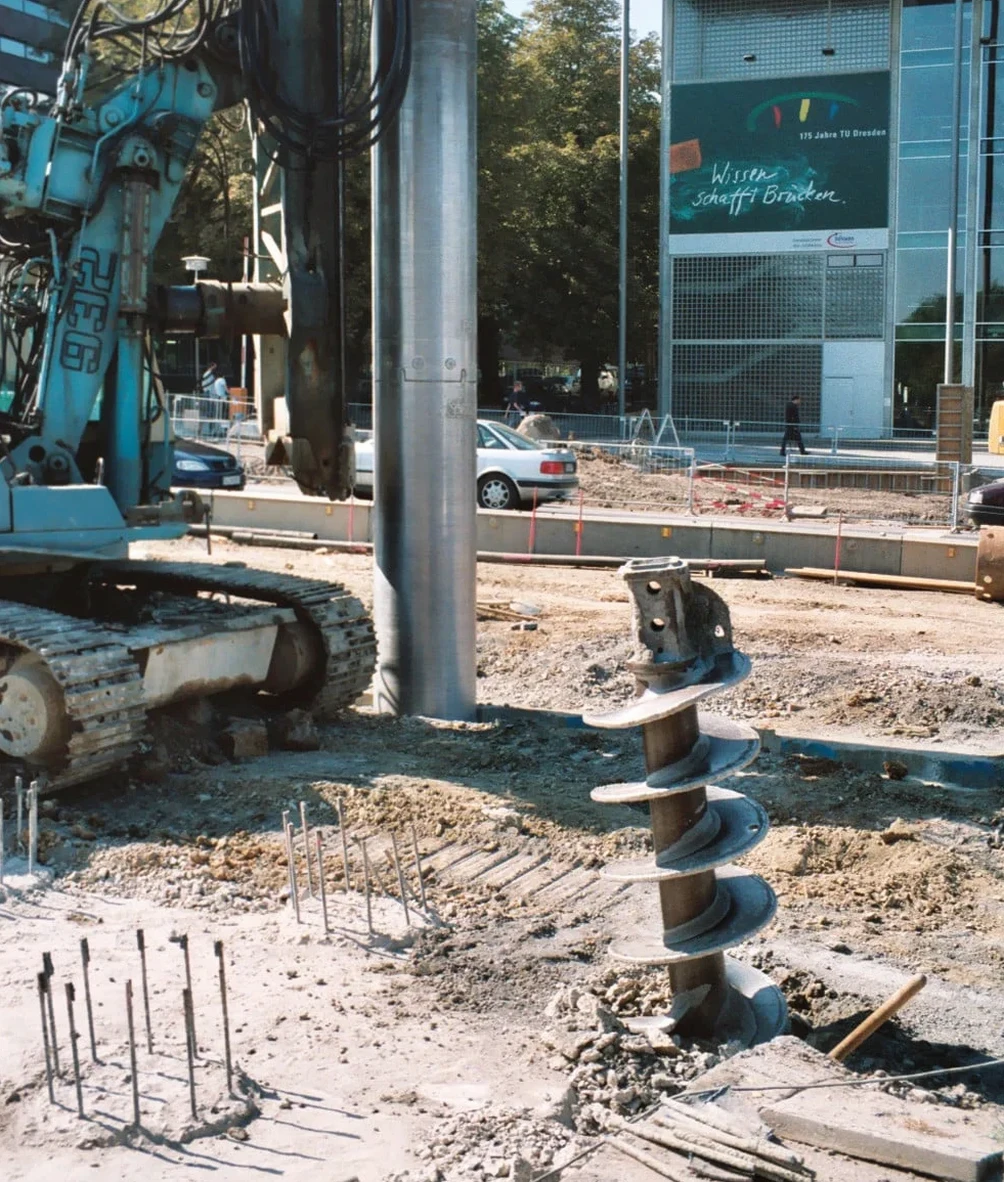
Between the weathered basalt ridges of Middle Ridge and the deep alluvial clays near Gowrie Creek, Toowoomba presents a split personality beneath the surface. One site might hit basalt at 1.5 metres while a neighbouring property 200 metres away requires socketing through over 6 metres of highly reactive residual soil. A pile foundation design that assumes uniform ground conditions across the city will fail at the first bore log. The Great Dividing Range gave Toowoomba its dramatic escarpment views, but it also left behind a geological patchwork where pile depth, diameter, and socket length must be calibrated for each borehole individually. We combine in-situ investigation data with SPT drilling logs and laboratory strength testing to develop pile designs that work with the actual stratigraphy, not a generic regional assumption.
A pile design in Toowoomba that ignores the weathered basalt transition zone can overestimate end-bearing capacity by 40% or more.
Area-specific notes
Toowoomba’s rapid expansion west toward Glenvale and Cotswold Hills during the 2000s pushed residential subdivisions onto land where the soil profile had never been properly characterised for deep foundations. Prior to that, most of the city’s development sat on proven basalt plateaus where shallow footings sufficed. The new corridors cross the Marburg Formation and the Walloon Coal Measures, introducing compressible layers, old mine workings in scattered pockets, and thickness variations that make pile design more than a routine exercise. A pile terminating in a thin basalt flow over a coal seam carries a completely different risk profile than one socketed into fresh, massive basalt at Middle Ridge. Differential settlement between piles on the same cap becomes the critical failure mode. Our pile foundation design in Toowoomba addresses this by running settlement analyses that account for the full stratigraphic column beneath each pile location, not just the average borehole.
Standards used
AS 1726:2017 – Geotechnical Site Investigations, AS 4678:2002 – Earth-Retaining Structures, AS/NZS 1170.0:2002 – Structural Design Actions (General Principles), AS/NZS 1170.1:2002 – Permanent, Imposed and Other Actions, AS/NZS 1170.4:2007 – Earthquake Actions in Australia, AS 2159:2009 – Piling – Design and Installation
FAQ
How much does a pile foundation design cost for a residential project in Toowoomba?
For a single-lot residential pile foundation design in Toowoomba, costs typically range from AU$2,600 to AU$5,200 depending on the number of boreholes, access constraints, and whether a site classification per AS 2870 is also required. Larger commercial or multi-storey projects with pile load testing specifications, group analysis, and detailed construction-phase monitoring can range from AU$5,500 to AU$9,280. All proposals include a fixed scope document so you know exactly which deliverables are covered before work begins.
Which Australian standards govern pile design in Queensland?
Pile foundation design is governed by AS 4678 and AS 2159, with geotechnical investigation requirements set by AS 1726. Structural loading follows the AS/NZS 1170 series. In Toowoomba, the local council may also reference the Queensland Development Code for specific foundation requirements on reactive soils.
How do you determine rock socket length in Toowoomba basalt?
Socket length is determined by the rock mass rating of the basalt, the unconfined compressive strength from core samples, and the required axial and lateral capacity. In weathered basalt common to Toowoomba, we use the Williams and Pells method with a reduction factor for joint infill. A borehole camera inspection confirms continuity before finalising the socket design.
Can you design piles for high-wind areas along the Toowoomba escarpment?
Yes. Pile designs for escarpment-edge sites include lateral load analysis for wind forces per AS/NZS 1170.2, which can exceed 2.5 kPa in exposed locations. The pile cap connection and upper shaft reinforcement are detailed to handle the overturning moments that control design in these high-wind exposure categories.