Together, we solve the challenges of tomorrow.
DISCOVER →In Toowoomba, where the landscape is shaped by the ancient basalts of the Main Range and the deep alluvial soils of the Darling Downs, understanding the ground beneath your feet is not just good practice—it’s essential. The Laboratory category encompasses all the controlled, high-precision testing performed on soil and rock samples to determine their physical and engineering properties. This critical phase of geotechnical investigation moves beyond field observations to provide the quantifiable data engineers need to design safe, durable, and cost-effective foundations, pavements, and earthworks. From residential slabs on the city’s reactive clay ridges to large-scale infrastructure anchoring into weathered rock, every project benefits from the certainty that only rigorous laboratory analysis can provide.
Toowoomba’s unique geology presents a complex testing environment. The region is notorious for its highly reactive basaltic clays, which can swell and shrink dramatically with moisture changes, posing a significant threat to light structures. Interspersed with these are zones of less reactive but more compressible alluvial silts along creek flats, and the decomposed rock profiles of the range itself. A simple field classification is insufficient here. Accurate laboratory testing, such as a detailed Atterberg limits analysis, is the only way to precisely classify these fine-grained soils and reliably predict their shrink-swell potential. This directly informs the footing design requirements mandated for residential construction, turning an unknown risk into a managed design parameter.
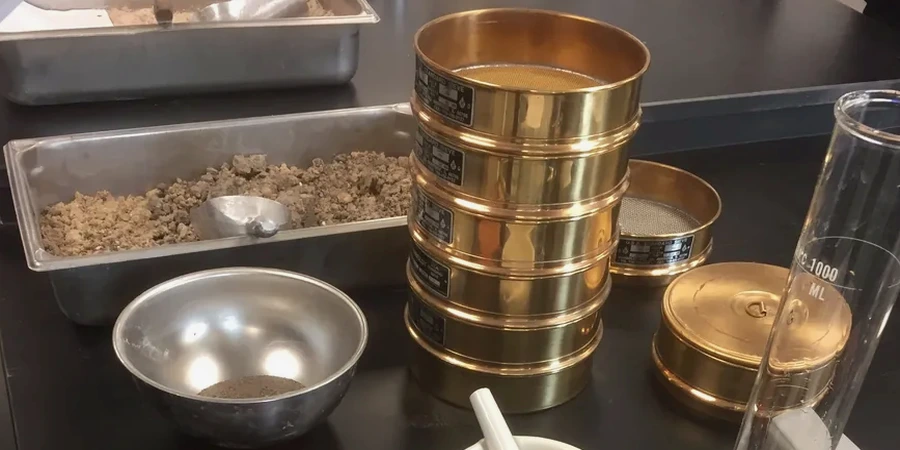
All testing procedures within this category are governed by the rigorous framework of Australian Standards, ensuring consistency, reliability, and legal defensibility of results. The primary standard is AS 1289, which details the methods of testing soils for engineering purposes. For instance, determining the particle size distribution through a grain size analysis (sieve + hydrometer) follows AS 1289.3.6.1 for sieving and AS 1289.3.6.3 for the hydrometer method, providing a complete picture of the soil’s makeup from coarse sands down to microscopic clay particles. Other crucial tests, like those for soil compaction characteristics (AS 1289.5.1.1) or California Bearing Ratio (AS 1289.6.1.1), are fundamental for road and pavement design, directly referencing Transport and Main Roads (TMR) specifications for regional projects.
The necessity for these laboratory services spans the full spectrum of construction and civil engineering in the Toowoomba region. A thorough Atterberg limits determination is the cornerstone of any residential site classification, as per AS 2870, directly influencing the design of your home’s slab or stumps. For commercial developments and multi-storey buildings, consolidation testing predicts settlement, while shear strength tests like triaxial compression are vital for bearing capacity and slope stability analyses. Civil infrastructure projects, from the Toowoomba Bypass to local road upgrades, rely heavily on a precise grain size analysis (sieve + hydrometer) and compaction tests to ensure fill materials meet strict specifications and will perform under heavy traffic loads without failing.
The primary purpose is to precisely determine the engineering properties of on-site soils and rock, such as strength, reactivity, and compressibility. In Toowoomba’s variable geology of reactive clays and alluvial silts, this data is essential for designing safe footings, predicting ground movement, and ensuring long-term structural integrity in accordance with Australian Standards like AS 2870 and AS 1289.
Field classifications are visual and tactile estimates, which are inherently limited. Laboratory testing provides quantifiable, repeatable measurements of properties like clay plasticity, exact grain size distribution, and compaction potential. For a reactive clay site in Toowoomba, an Atterberg limits test in the lab can measure the precise shrink-swell index, a critical value a field log cannot supply.
The core standard is the AS 1289 series, 'Methods of testing soils for engineering purposes,' which covers everything from sample preparation to specific tests like hydrometer analysis and triaxial strength. For residential work, the site classification derived from these tests must comply with AS 2870, 'Residential slabs and footings.' Infrastructure projects also adhere to Queensland TMR specifications.
The required suite of tests is dictated by the project type, the soil conditions encountered, and the design loads. A typical residential investigation will always need Atterberg limits to classify reactivity. A larger commercial or road project will also require strength, compaction, and consolidation testing. The geotechnical engineer designs the laboratory program to answer the specific questions raised by the site investigation and the proposed structure.