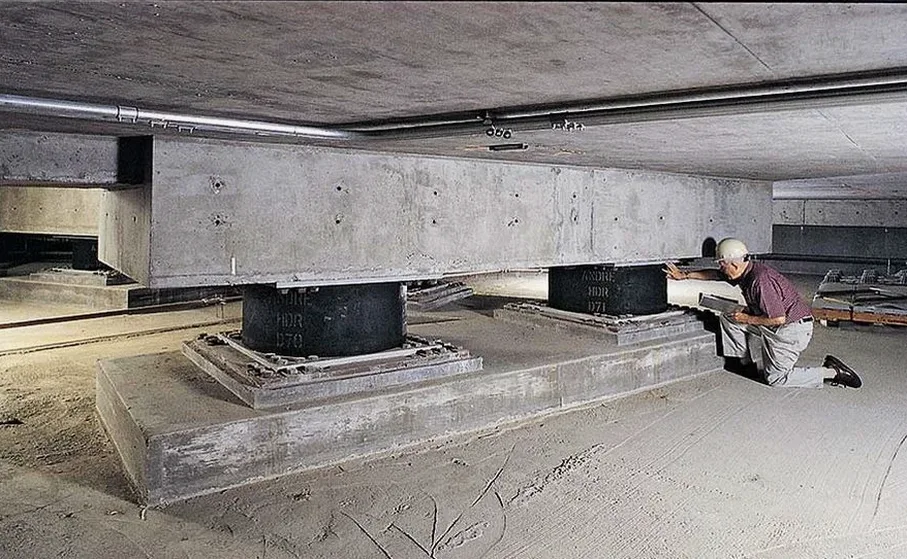
In Toowoomba, sitting up on the Great Dividing Range at around 700 metres, many builders assume seismic loads are just a coastal concern. That assumption catches people out. The basalt cap that defines the Toowoomba plateau creates stiff site conditions that, under AS 1170.4, can actually amplify short-period ground motion more than a deep soil profile would. We have seen relatively modest new builds on the eastern escarpment encounter cracking within five years where the structure interacted poorly with the weathered profile. A base isolation seismic design approach decouples the superstructure from that ground movement, giving you a building that moves less and ages better. For projects over reactive clays near the range edge, we often combine the isolation assessment with a site classification via MASW to nail down the actual site period before locking in the isolator parameters.
A properly tuned base isolation system on the Toowoomba plateau can reduce the lateral force demand on the superstructure by 40 to 60 percent compared to a fixed-base design.
Area-specific notes
AS 1170.4 Clause 2.2 is pretty blunt about what happens when you ignore base shear amplification on stiff sites — and around Toowoomba, where the basalt is shallow or exposed, you are often sitting on a Class B site. A fixed-base building on Class B can attract a higher seismic coefficient than the same building on Class D in Brisbane, simply because the spectral shape peaks at a shorter period. If the structural period of your frame happens to coincide with that peak, you get resonance, and the inertial forces climb fast. Base isolation shifts the fundamental period well out of that danger zone, into the long-period tail of the spectrum where spectral accelerations are low. The other risk here is isolation gap closure — if the moat wall is poured too tight, or if services are rigidly connected, you lose the isolation effect entirely. Our detailing accounts for the full design displacement plus an allowance for torsional rotation, which is something that generic interstate details sometimes miss for local basalt-founded buildings.
FAQ
What does base isolation seismic design cost for a typical building in Toowoomba?
For a standard commercial or light-industrial building in Toowoomba, the full design package — including site-specific hazard analysis, isolator selection and specification, and construction support — typically runs between AU$7,080 and AU$14,550, depending on the structural complexity and the number of isolator units. A simple rectangular footprint with elastomeric bearings sits at the lower end; a building with multiple expansion joints or sliding pendulum isolators will push toward the upper range because of the extra analysis and detailing involved.
Does a building on basalt rock in Toowoomba really need base isolation?
It can, yes — and the reason is counter-intuitive. Stiff rock sites like the basalt cap in Toowoomba amplify short-period ground motion. If your building's natural period is in that short-period range, you get higher lateral loads than you would on softer ground. Base isolation deliberately lengthens the structural period to around 2 to 3 seconds, where the spectral acceleration drops off sharply. For essential facilities or buildings with expensive internal fit-outs, the cost of isolation is often less than the cost of repairing earthquake damage over the life of the building.
How do you handle the interface between the isolators and the weathered basalt?
The critical detail is the plinth under each isolator. We specify a minimum bearing capacity and a flatness tolerance that is tighter than a standard footing — typically 3 mm over a 600 mm plate. In weathered basalt, we often specify a thin blinding layer of high-strength, non-shrink grout to achieve that tolerance. The plinth reinforcement is designed to transfer the isolator shear into the foundation without local punching, and we require a CPT or test pit confirmation of rock quality directly beneath each isolator location because the weathering profile can vary over just a few metres in Toowoomba.