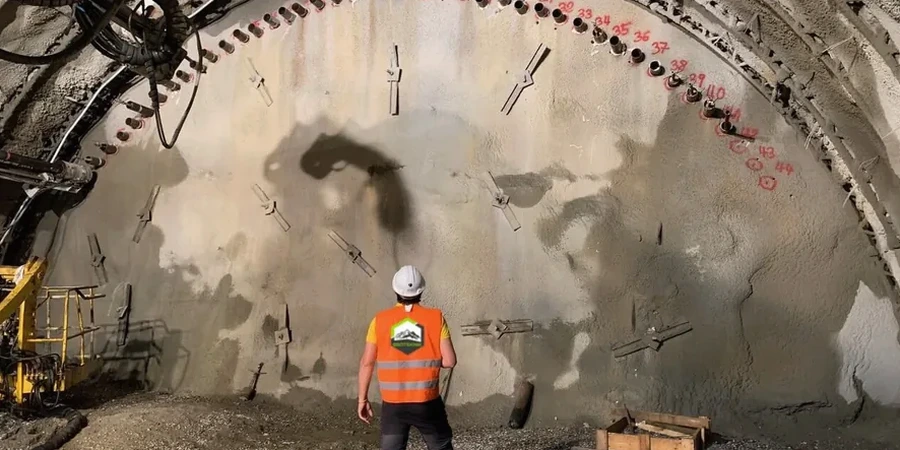
Toowoomba’s expansion across the eastern escarpment has accelerated with major infrastructure and multi‑storey residential projects pushing excavation depths beyond six metres, often into the weathered basalt and residual clay profiles that characterise the Main Range. The city’s average elevation of roughly 700 metres exposes sites to rapid moisture changes, and the layered colluvium overlying fresh rock creates a groundwater regime that can shift within a single wet season. Our team deploys geotechnical excavation monitoring systems that combine automated total stations with in‑place inclinometers and vibrating‑wire piezometers, giving project managers a continuous feed of deformation and pore‑pressure data rather than relying on periodic walk‑by inspections. For deep basement cuts near the Toowoomba CBD, where adjacent heritage masonry structures are sensitive to differential settlement, we typically pair the monitoring array with a targeted slope stability assessment to validate the temporary support design before the first bench is cut.
When the weathered basalt gives way to a slickensided clay seam at six metres, a five‑minute data gap can cost more than the entire instrumentation budget.
Area-specific notes
The most common mistake we see in Toowoomba is a contractor treating the weathered basalt like a uniform rock mass and skipping inclinometer installation because the bench looked ‘solid’ during trimming. That assumption collapses the moment a thin, clay‑filled joint set is intersected — the block can rotate almost without warning, and once the movement propagates to the surface, the shoring system is already playing catch‑up. Without real‑time monitoring, the first sign of trouble is often a crack in the kerb twenty metres behind the wall, which triggers a Worksafe notification, a stop‑work order, and a redesign cycle that burns three to four weeks. A properly instrumented excavation catches the deformation while it is still a sub‑millimetre creep, allowing the engineer to adjust the construction sequence or add localised Improvement before the problem escalates into a regulatory event.
FAQ
How much does geotechnical excavation monitoring cost for a typical Toowoomba basement dig?
For a standard single‑level basement with automated total station and two inclinometer arrays, budget between AU$1,280 and AU$4,460 for the monitoring programme duration, depending on the number of instruments, reading frequency, and reporting level required by the superintendent.
Which Australian standard governs excavation monitoring in Toowoomba?
The primary reference is AS 1726‑2017 (Geotechnical Site Investigations), which sets out requirements for instrumentation and monitoring. AS 4678‑2002 (Earth‑Retaining Structures) provides performance criteria for the supported excavation, while AS/NZS 1170 defines the loading and serviceability limits that trigger the monitoring thresholds.
What is the minimum dataset needed before starting monitoring?
We require a factual geotechnical report with borehole logs, a ground model identifying the interface between residual clay and weathered basalt, a numerical analysis of the expected wall deflection under staged excavation, and a schedule of trigger levels agreed with the design engineer. Without these, the monitoring system cannot be calibrated to a meaningful baseline.
Can the system detect movements in neighbouring buildings before cracks appear?
Yes. Crack gauges with 0.01‑mm resolution and robotic total station prisms fixed to the building facade typically detect tilt and settlement two to three weeks before visible cracking occurs, provided the baseline survey was completed before excavation started.
How do Toowoomba’s basalt soils affect the monitoring setup?
The weathered basalt profile often contains perched groundwater and slickensided clay seams that cause sudden, stick‑slip movements. We therefore specify higher‑frequency inclinometer readings (every 15 minutes during active excavation) and install piezometers at two depths — one above the clay seam and one in the fractured rock — to capture the dual‑aquifer response that drives instability.