A site investigation on the eastern edge of Toowoomba, near the escarpment overlooking the Lockyer Valley, recently encountered basalt-derived residual clays that changed consistency radically within a metre of depth. The excavation crew noticed that the material went from stiff and fractured to soft and sticky after a 20 mm rain event overnight. That kind of field observation tells you something is happening with the clay fraction, but it takes a set of Atterberg limits tests under AS 1289.3.1.1, AS 1289.3.2.1, and AS 1289.3.3.1 to quantify the liquid limit, plastic limit, and plasticity index. In Toowoomba, where reactive basaltic clays meet transported alluvial silts along the Eastern and Western Creeks, knowing the exact moisture boundaries where soil behaviour shifts from plastic to liquid is not academic—it directly governs footing depth, pavement subgrade treatment, and retaining wall drainage design. We run Atterberg limits on every project that encounters fine-grained material, and the numbers we produce feed directly into geotechnical models used by structural engineers across the Darling Downs.
The plasticity index is not just a number on a lab report—it is the difference between a footing that performs for 50 years and one that heaves in the first wet season.
Area-specific notes
Toowoomba sits on the edge of the Main Range Volcanics, and the basalt weathering profile produces clay-rich soils that can exceed a plasticity index of 30%—placing them firmly in the high to very high reactivity class under AS 2870. When these soils take on water during the summer storm season between November and March, the volume change can lift lightly loaded slabs and crack masonry walls. Atterberg limits give the site classifier the quantitative threshold: a PI above 20% in Toowoomba typically triggers a deeper beam depth, additional reinforcement, or even a suspended floor system in the worst zones around Middle Ridge and Rangeville. The liquid limit also acts as a practical warning for earthworks contractors—soils with LL above 50% become unworkable after rain, leading to days of lost production if the site is not managed with weather protection and drainage cut-offs. Skipping this test on a Toowoomba site with known basalt clays is a direct path to post-construction movement claims.
FAQ
What do the Atterberg limits actually tell an engineer about Toowoomba soil?
The liquid limit defines the moisture content where the soil transitions from plastic to liquid behaviour—essentially, the point where it stops being a solid and starts flowing under its own weight. The plastic limit marks the moisture threshold where the soil loses plasticity and crumbles. The difference, the plasticity index, gives a direct measure of how much water the clay can absorb while remaining in a workable, plastic state. In Toowoomba's basalt-derived clays, a PI above 25% signals high reactivity under AS 2870, meaning the soil will undergo significant shrink-swell with seasonal moisture changes. Engineers use these numbers to select footing depths, assign site classifications (M, H1, H2, E), and specify subgrade lime stabilisation targets.
How much does Atterberg limits testing cost in Toowoomba?
A full set of Atterberg limits—liquid limit, plastic limit, and plasticity index—typically runs between AU$100 and AU$170 per sample, depending on whether linear shrinkage is included and how many points are run on the Casagrande flow curve. Volume pricing applies for site investigations with 10 or more samples. We provide a fixed quote upfront once we know the number of samples and the required turnaround time, with no hidden bench fees.
How long does the test take from sample drop-off to results?
Standard turnaround is three working days from the time the sample arrives at the lab in a sealed, moisture-retaining container. The test itself involves oven-drying stages that cannot be rushed without compromising accuracy—the AS 1289 methods specify drying to constant mass, which takes time. We offer a 24-hour express service for urgent project milestones, subject to lab capacity and an additional surcharge.
Can Atterberg limits be done on-site or only in the lab?
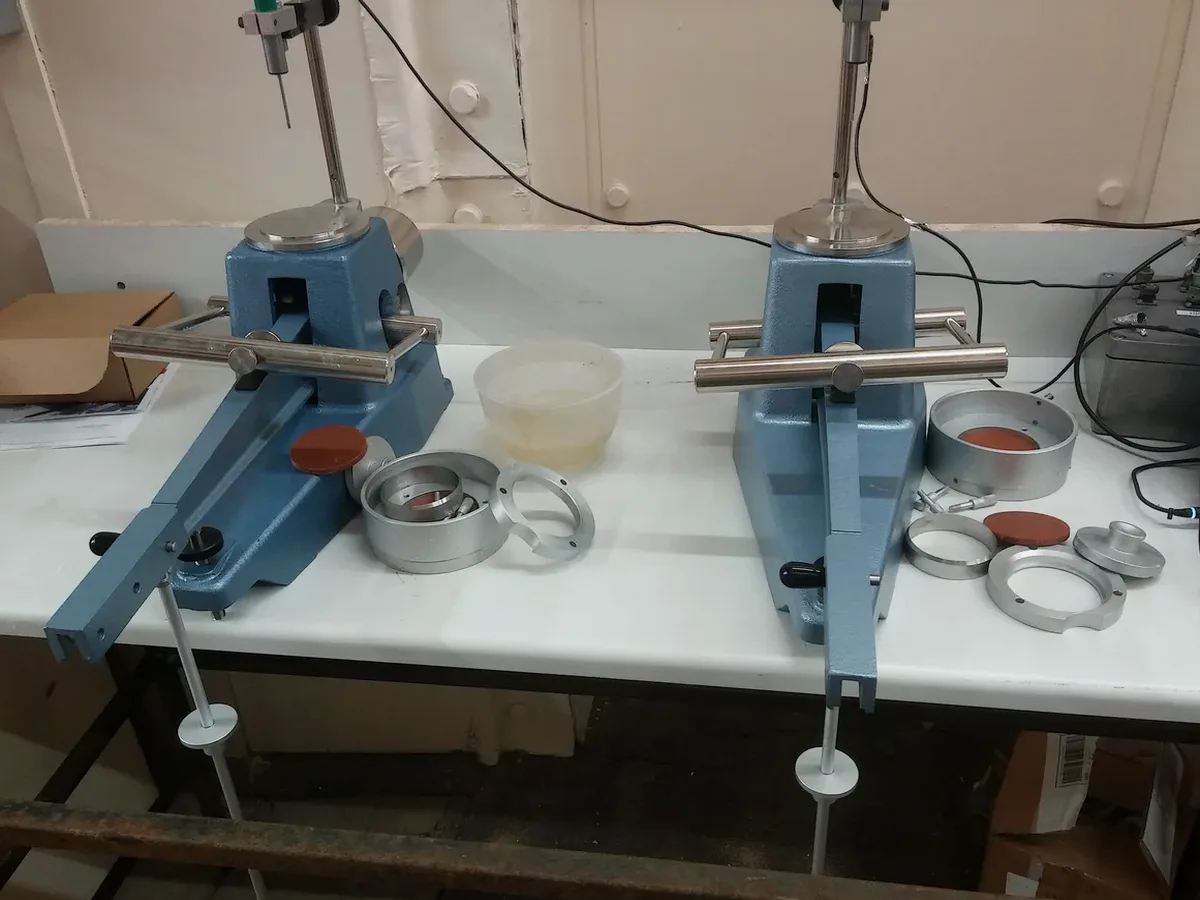
The full multipoint determination to AS 1289 requires a controlled laboratory environment: a calibrated Casagrande device, a balance readable to 0.01 g, a drying oven, and a desiccator. Field approximations—sometimes called «speedy» plasticity estimates—exist, but they are not accepted for design purposes or AS 2870 site classification in Toowoomba. We do offer a mobile sampling service where our technician collects undisturbed bag samples from your excavation and transports them under chain-of-custody to the Toowoomba lab, ensuring no moisture loss between the site and the bench.