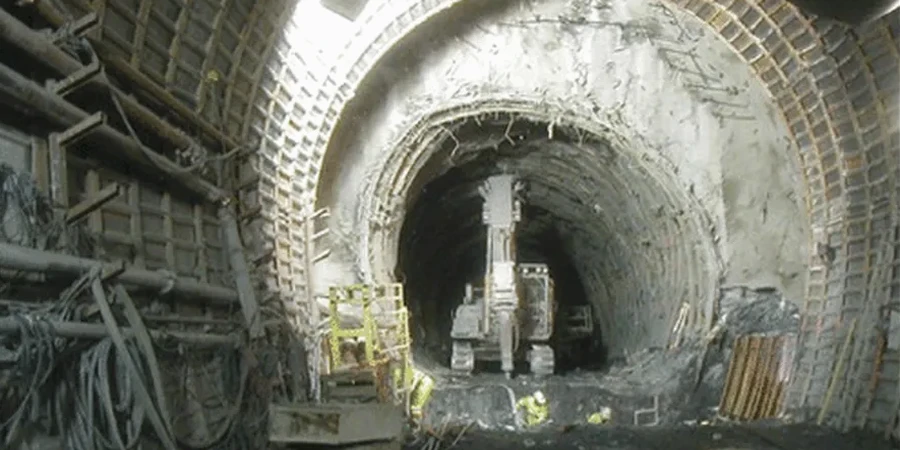
A stormwater diversion tunnel on the eastern escarpment hit a lens of saturated black clay at 14 metres depth, and the face started squeezing within hours. That is the reality of tunnelling through Toowoomba’s residual basalt soils and Gowrie Creek paleochannels — materials that behave like stiff rock when dry but lose half their strength once moisture exceeds the plastic limit. Our laboratory team runs the full suite of index and strength tests on Shelby tube samples and SPT split spoons recovered from geotechnical drilling, building a ground model that tells the contractor exactly where the soft zones sit, how far they extend, and what support pressure the TBM or roadheader must hold. In basalt terrain the risk is not uniform conditions; it is lenses and relict joints filled with montmorillonitic clay. We also correlate lab data with field CPT testing when access allows, giving a continuous profile of tip resistance and pore pressure across transitions from weathered rock to alluvium.
Toowoomba’s basalt clays can lose 50% of their undrained strength on remoulding; we quantify that sensitivity ratio so the support design is not a guess.
Area-specific notes
The Great Dividing Range escarpment that defines Toowoomba’s eastern edge creates a perched groundwater table inside the weathered basalt profile, typically within 6 to 12 metres of surface in the East Creek and West Creek catchments. Tunnel drives that cross under these drainages encounter flowing ground where the clay-sand transition allows rapid pore pressure equalisation; without advance probe holes and real-time piezometer data, a face collapse can daylight at street level within hours. The second hazard is shrink-swell fatigue on the permanent lining: residual clays with liquid limits above 70 impose swelling pressures that exceed the 100 kPa design assumption common in southern capitals, demanding site-specific swell testing and longer curing times for shotcrete primary support. AS 4678 Appendix C provides the design approach, but the input parameters must come from cores taken on the alignment, not from regional databases that average out the worst lenses.
Standards used
AS 1726 Geotechnical site investigations, AS 4678 Earth-retaining structures (tunnel support design clauses), AS 1289 suite — Methods of testing soils for engineering purposes, AS/NZS 1170 Structural design actions (seismic and earth pressure combinations), AS 1289 — Consolidated undrained triaxial compression test (referenced for tunnel projects), ITA-AITES Guidelines for Tunnelling in Soft Ground (supplementary reference)
FAQ
What is the typical cost range for a soft-ground tunnel geotechnical analysis in Toowoomba?
Depending on the number of boreholes, sample depth, and test complexity, a complete laboratory programme for a soft-ground tunnel alignment in Toowoomba generally runs between AU$6,010 and AU$24,700. Small-diameter utility tunnels at shallow depth sit at the lower end; full TBM drives with multiple triaxial suites and swell testing across several units reach the upper end.
Which soil units in Toowoomba are classified as soft ground for tunnelling?
Quaternary alluvium along Gowrie Creek, East Creek, and West Creek corridors, plus deeply weathered basalt clays with SPT N-values below 8 and sensitivity ratios above 4. These materials can exhibit squeezing behaviour and require face support pressures above 80 kPa during excavation.
How long does laboratory testing take for a tunnel project?
Index testing and classification can be reported within 5–7 working days of sample receipt. Consolidated-undrained triaxial and swell testing require 3–4 weeks due to saturation and consolidation stages. We schedule batches to align with the excavation advance so that critical parameters are available before the face enters each new unit.
Do you perform NATA-accredited testing for tunnel projects?
Yes, all testing is conducted under our NATA-accredited quality system to the relevant AS 1289 methods, with full traceability from sampler to report. Accreditation covers triaxial, Atterberg, particle size distribution, consolidation, and swell testing required for AS 4678 design inputs.