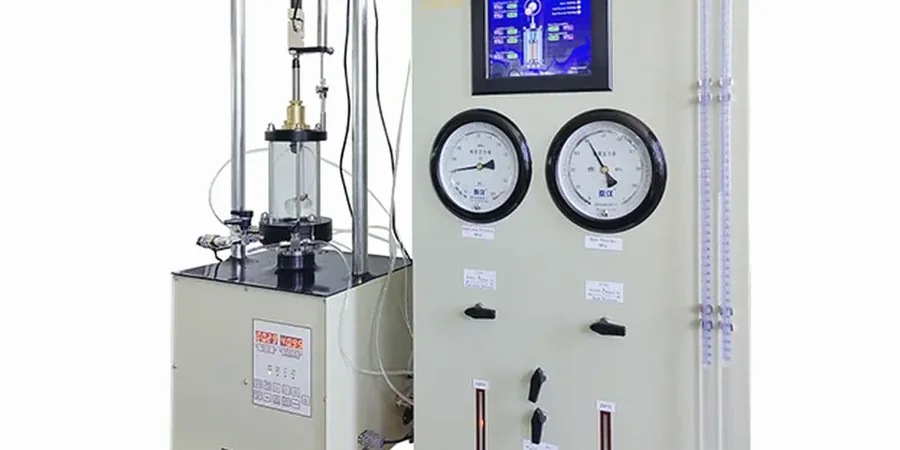
Between the hard ridgelines of Middle Ridge and the softer alluvial flats of Gowrie Creek, the geotechnical profile across Toowoomba shifts abruptly within a single building lot. A site on weathered basalt can yield extremely stiff residual clay with a plasticity index above 35, while a property closer to Westbrook Creek sits on loose quartz-rich alluvium that barely holds structure in a Shelby tube. When both profiles appear on the same project—common for the split-level developments creeping down the eastern escarpment—the undrained shear strength measured by a quick UU triaxial on the basalt-derived clay tells a completely different story than a consolidated-drained test on the alluvial lens beneath it. Our triaxial testing laboratory in Toowoomba runs the full suite of CU, CD, and UU procedures under AS 1289.6.4.1 so that the designer gets effective stress parameters and total stress parameters from the same stratigraphic column, without having to stitch together data from two labs. For projects where the residual soil overlies extremely weathered rock, we often pair the triaxial stage with a test pit investigation to log the transition zone between Class V and Class IV material before selecting the confining pressure range for the multistage test program.
We run B-value checks above 0.95 on every CU specimen before shear, because an unsaturated sample of Toowoomba basalt clay can overstate the cohesion intercept by 40 per cent.
Scope of work
AS 1289.6.4.1 requires that the specimen be trimmed to a diameter of at least 50 mm and that the height-to-diameter ratio fall between 2.0 and 2.5, which becomes operationally critical in Toowoomba because the desiccated crust that caps many basalt profiles cracks during extrusion if the moisture condition isn't adjusted in the humidified trimming cabinet. Our laboratory addresses this by conditioning each sample inside a controlled-environment chamber at 95 per cent relative humidity for a minimum of 48 hours before trimming, then running a B-value saturation check on every CU specimen to confirm Skempton's parameter exceeds 0.95 before the shear stage begins. We routinely apply back-pressure saturation in the triaxial cell at 300 to 500 kPa for the tight basaltic clays that dominate the eastern suburbs—samples that would otherwise yield misleadingly high cohesion intercepts if consolidated at field overburden pressure without full saturation. The consolidation phase follows the incremental loading procedure set out in the standard, with volume-change readings logged at 0.1 mL resolution until the double-drainage path produces at least 95 per cent primary consolidation on the Taylor square-root-of-time plot. In multistage CU tests on a single specimen, we limit each stage to axial strain below the peak deviator stress so that the failure envelope built from three confining pressures still respects the requirement of three independent Mohr circles, which is the only way to derive a defensible effective friction angle for the stiff residual soils that underpin much of the city's mid-rise construction.
Area-specific notes
The basalt-derived residual clays that cover most of Toowoomba's developed area contain relic joint planes coated with iron-manganese oxides, and these surfaces act as pre-existing planes of weakness that a standard triaxial specimen cannot always capture if the joint dips more than 15 degrees from the horizontal loading axis. When a CU triaxial test is run on a specimen that inadvertently contains a slickensided joint, the apparent cohesion can drop to near zero while the friction angle remains deceptively high, giving the designer a set of parameters that would be unconservative for a cut batter in the Range escarpment where the joint orientation parallels the slope face. Our laboratory protocol mitigates this by requiring a detailed visual log of every extruded Shelby tube before the specimen is selected—if any polished or striated surface is observed, the sample is either reoriented so the joint plane lies outside the anticipated failure zone, or it is flagged as a discontinuum-controlled strength case that requires separate shear strength testing on the actual joint surface. In the alluvial corridors along Gowrie Creek and Westbrook Creek, the risk shifts from structural defects to sample disturbance: the loose silty sands lose cementation during transport, and a triaxial test on a disturbed specimen will return an effective friction angle two to four degrees lower than the true in-situ value, which in turn can trigger an unnecessary Improvement scope costing the project tens of thousands of dollars.
FAQ
What is the typical turnaround time for a CU triaxial test in Toowoomba?
For a multistage CU triaxial on a single specimen, the laboratory requires approximately 10 to 14 working days from the date the undisturbed sample arrives. The consolidation phase alone can take three to five days for the stiff basaltic clays common in Toowoomba, because the low hydraulic conductivity of these materials slows the double-drainage path. If the project requires multiple specimens—for example, a UU suite on three Shelby tubes plus a CU multistage—the full program typically runs 15 to 20 working days. We can accelerate the schedule with prior arrangement when the sample delivery is timed to align with the start of a consolidation cycle.
How much does a triaxial test cost in Toowoomba?
A multistage CU triaxial test with back-pressure saturation, pore pressure measurement, and a full Mohr-Coulomb report typically runs between AU$2,550 and AU$4,450 depending on the number of confining stages and whether the specimen requires special conditioning in the humidified trimming cabinet. A UU triaxial suite on three separate specimens falls toward the lower end of that range. The final cost is confirmed once we review the sample condition and the required confining pressure range for the specific stratigraphic unit.
What sample quality is required for a valid triaxial test?
The standard requires undisturbed samples obtained with a thin-walled Shelby tube or block sampling, with a minimum diameter of 50 mm and length sufficient to trim a specimen with a height-to-diameter ratio of 2.0 to 2.5. For the residual basaltic clays in Toowoomba, we strongly recommend that the Shelby tubes be sealed with wax at both ends immediately after extrusion on site and transported in a foam-lined crate to minimize vibration-induced disturbance. Any sample showing visible cracks, desiccation, or swelling upon extrusion is logged and flagged before trimming, because disturbance can reduce the measured effective friction angle by several degrees.
Which triaxial test type should I specify for a retaining wall design in Toowoomba?
For retaining walls founded on or retaining the basaltic residual clays that dominate Toowoomba's geology, AS 4678 recommends that both drained and undrained strength parameters be evaluated. A CU triaxial with pore pressure measurement provides the effective stress parameters (c' and φ') needed for long-term drained analysis, while a UU triaxial suite supplies the undrained shear strength for short-term construction-stage stability. If the wall retains a cut in the Range escarpment where relic joint planes are present, we also recommend a separate direct shear test on the joint surface, as the triaxial specimen may not capture the discontinuum-controlled strength correctly.