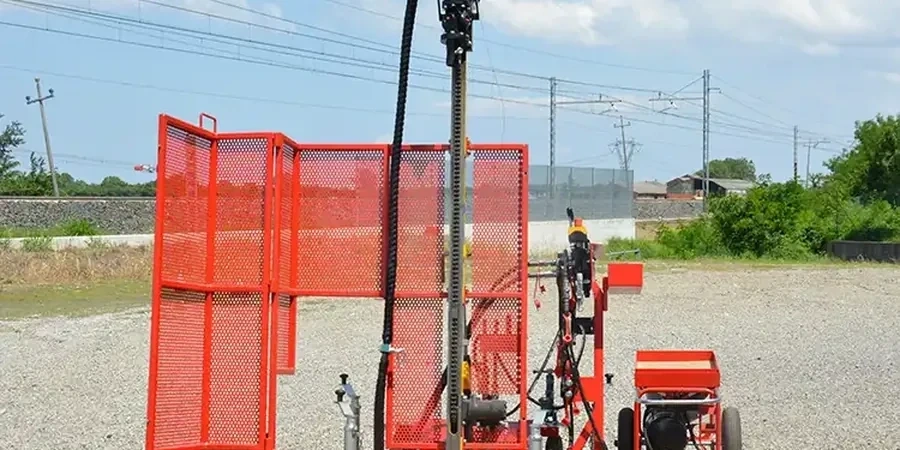
The split-spoon sampler drives into the ground with a 63.5 kg hammer falling 760 mm, and that rhythmic thud is what tells you everything you need to know about the soil profile beneath Toowoomba. Our crews run truck-mounted rigs where access is open, and compact crawler units for the tighter residential blocks up on the Range escarpment. The red-brown and black cracking clays derived from the Main Range Volcanics respond differently to dynamic penetration than the alluvial silts down in the Lockyer Valley floodplain, and reading those N-values correctly takes local experience. We log every 150 mm of penetration to AS 1726, and when the sampler hits fresh dolerite at 4 or 5 metres — common on the eastern side of the escarpment — we record the refusal depth and switch to rock coring if the foundation design calls for it. Before scheduling boreholes on a site near Prince Henry Heights, we often cross-check surface geology with a test pit to confirm the depth of colluvium, especially after the wet season when clay heave can obscure the natural ground line.
In Toowoomba's basalt clays, a raw N-value of 15 in August can drop to 6 in February — seasonal moisture is the variable that separates a safe bearing capacity from a call-back.
Area-specific notes
The escarpment climate swings between drought and torrential downpours, and that contrast reshapes how we interpret SPT refusal depths. A borehole drilled in October on a dry ridge near Middle Ridge might hit refusal at 2.5 metres in what looks like competent rock, but the same pad in March after 200 mm of rain shows the auger sinking another metre through softened dolerite that wasn't there before. The risk isn't the rock itself — it is mistaking a seasonal perched water table or a lens of decomposed basalt for a sound founding stratum, then having the contractor excavate and find slop. We cross-reference every SPT log with the Toowoomba Regional Council's geotechnical hazard maps, particularly the landslide susceptibility zones along the escarpment edge, because a footing designed on an N-value from a dry borehole can become under-designed the moment the ground saturates. In the black soil plains west of the city, the bigger concern is shrink-swell — the N-values look fine in the dry season but the plasticity is through the roof, and that is where an Atterberg limits test run on the split-spoon sample saves the structural engineer from a nasty surprise later.
FAQ
What does an SPT test cost for a residential site in Toowoomba?
For a standard residential investigation with two boreholes to 4–5 metres depth, SPT testing in Toowoomba typically runs between AU$760 and AU$1,020 including the engineer's log and a summary report. The final figure depends on access — steep blocks on the escarpment edge sometimes need a crawler rig instead of a truck-mounted unit — and whether you need NATA-registered lab testing on the split-spoon samples.
How does Toowoomba's basalt geology affect SPT N-values?
The residual clays derived from the Main Range Volcanics can give deceptively high N-values when dry — 20 to 30 in summer — but the same material softens dramatically after rain and the N-value can halve. We log the moisture condition at the time of drilling and often recommend a second borehole in a wetter season if the first was drilled during a drought, particularly for sites on the western black soil plains where shrink-swell potential is high.
What depth do you usually reach refusal in Toowoomba?
On the eastern side of the escarpment — areas like Prince Henry Heights, Rangeville, and parts of East Toowoomba — refusal in fresh or slightly weathered dolerite is common between 4 and 6 metres. On the western side toward the black soil plains, refusal can be deeper than 10 metres or not reached at all within the standard SPT depth, because the alluvial and colluvial deposits are much thicker. The Toowoomba Regional Council often requests rock coring once refusal is reached, to confirm the rock is competent and not just a boulder.
Do you apply energy corrections to the SPT N-values?
By default we report raw uncorrected N-values, which is what most local geotechnical and structural engineers in Toowoomba use for bearing capacity calculations under AS 4678. If the project requires liquefaction assessment or site classification to AS 1170.4, we apply N60 corrections (energy ratio, rod length, borehole diameter, and overburden) and provide both raw and corrected values in the log. The automatic trip hammer we use typically delivers an energy ratio around 80%, so the correction factor is usually close to 1.0.